
How to Choose the Right Marketing Agency for Lab Equipment & Scientific Instruments (2026 Guide)
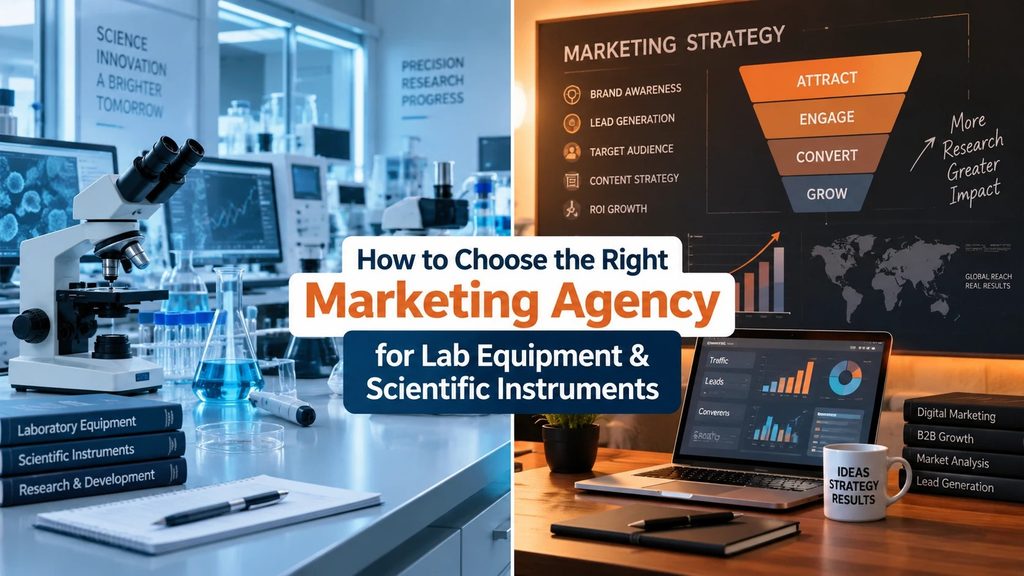
Let’s be honest — finding a marketing agency that actually understands the lab equipment world is harder than it should be.
Most companies in this space have been there. You hire an agency that looks great on paper, they talk about “growth funnels” and “brand storytelling,” and then three months in you’re staring at a campaign that could’ve been written for a furniture store. Your buyers — researchers, lab managers, procurement heads — see right through it. And you’re left wondering where the budget went.
So before you sign anything in 2026, here’s what you actually need to look for.
Why Most Agencies Simply Don’t Get It
The laboratory and scientific instruments market isn’t difficult to market in because the products are complex. It’s difficult because the buyers are complex.
Think about who you’re trying to reach. A senior scientist who’s spent fifteen years working with chromatography systems. A procurement officer managing vendor lists for a pharmaceutical company. A lab director who needs to justify a $200,000 capital purchase to a CFO who doesn’t know what mass spectrometry is.
This audience doesn’t care about clever taglines or slick visuals. What moves them is accuracy — specific numbers, proof that you’ve actually done this before. Most agencies just don’t have a playbook for that.
Then there’s the sales cycle. Six months is normal. Eighteen isn’t rare. An agency that’s used to running thirty-day campaigns is going to get twitchy — they’ll want to change strategy after week three because “nothing’s happening,” or they’ll hand you a report full of metrics that look great on paper but have nothing to do with where your actual pipeline stands.
None of this means generalist agencies are bad at their jobs. They’re just built to win in a different kind of market than this one.
7 Things That Separate a Good Lab Marketing Agency from a Risky One
1. Real Experience in Scientific or Technical Industries
This is the first question to ask, and you want a specific answer — not “we’ve worked with B2B companies across multiple sectors.”
How many lab equipment or scientific instrument clients have they actually served? Can they show you case studies from those engagements? Do they understand the difference between a distributor and a direct sales model in this space?
General B2B experience is table stakes. What you’re looking for is someone who’s already made the mistakes, learned the nuances, and knows what works for this audience specifically.
2. Content That Scientists Will Actually Read
Here’s a quick test: ask the agency to show you a technical article or product page they’ve written for a scientific client. Read the first two paragraphs.
Does it sound like it was written by someone who knows the industry? Or does it sound like someone described the product to a copywriter who then dressed it up with adjectives?
In lab equipment marketing, weak content doesn’t just underperform — it actively damages your credibility. A scientist who reads something technically inaccurate about your product won’t call you. They’ll move on, and they’ll remember.
3. A Lead Generation Approach Built for Long Sales Cycles
Brand awareness is valuable. But it’s not a strategy on its own.
When you’re evaluating an agency, ask them to walk you through exactly how they’d handle a lead generation campaign for a laboratory equipment company. What channels do they use? How do they define a qualified lead in your context? What happens to a prospect who’s in the research phase for three months before they’re ready to take a demo call?
If their answer sounds like “we’ll run some ads and see what converts,” that’s not enough. You need an agency that knows how to nurture a scientific buyer over a long evaluation window — not just generate clicks.
4. They Start With Market Analysis, Not Tactics
A lot of agencies will jump straight to campaign planning. That’s a red flag.
Before any good strategy gets built, someone needs to dig into where your brand actually sits in the market — who your competitors are, how your buyers search and evaluate options, and where the gaps in your positioning are. A proper market analysis for laboratory equipment companies should shape everything that comes after: your messaging, your channel mix, your content priorities.
Agencies that skip this step are essentially guessing. And in a niche market where your audience is small and skeptical, guessing is very expensive.
5. They Support Sales, Not Just Marketing
Here’s something that doesn’t get talked about enough: in scientific instrument sales, marketing doesn’t end when the lead gets passed to your sales rep.
The rep needs materials. Comparison documents, ROI breakdowns, application notes for specific use cases, responses to technical objections. The buying process in this industry involves multiple stakeholders, and your sales team needs content for each conversation they’re having.
An agency that offers sales enablement alongside their marketing work understands this. They build content that serves both pipeline generation and deal closure — which means you’re getting more value from the same investment.
6. They Know Your Buyers’ Geography and Verticals
A pharmaceutical QC lab in New Jersey thinks differently than a university research group in California. Procurement processes, budget cycles, regulatory considerations, even the trade events they attend — these things vary significantly.
Ask any agency you’re evaluating whether they have experience in the specific regions and verticals that matter most to your business. Geographic and sector-specific knowledge isn’t just a nice-to-have. It directly affects how accurate and effective your targeting will be.
7. Their Reporting Is Tied to Business Outcomes
At this point, there’s no good reason for an agency to hand you a report full of impressions and engagement numbers that never connect back to the pipeline.
Ask to see a sample report before you sign anything. What you actually want to see: qualified leads generated, cost per qualified lead, lead-to-meeting conversion rate, marketing-influenced pipeline. If what they show you is follower growth and post reach — and nothing tying it to revenue — that’s your answer. Keep looking.
Red Flags Worth Watching For
A few things that should make you pause:
- They pitch tactics before asking about your buyers. If the first meeting is about LinkedIn ads and SEO before they’ve asked who your customer is, that’s backwards.
- They can’t describe your audience without you explaining it. An agency that already works in this space should be able to articulate what motivates a lab director to evaluate new equipment.
- No performance benchmarks in their contracts. Agencies that resist tying deliverables to outcomes are usually protecting themselves, not you.
- Their portfolio is all consumer or SaaS brands. Strong results in those categories don’t transfer to scientific instrumentation.
What Working With a Specialist Actually Feels Like
When you work with an agency that was built for this market, the onboarding conversation is completely different. You don’t spend the first month explaining what your product does or why your sales cycle takes so long. They already know.
That translates directly into faster execution, better content quality, and campaigns that reach the right people with the right message from day one.
Cresoltek is a laboratory technology marketing agency designed specifically for this space. With over two decades of hands-on experience across lab equipment, scientific instruments, and life sciences, the team understands technical buyers, long sales cycles, and what it actually takes to build a qualified pipeline in this industry.
From strategic marketing planning and market research to lead generation, sales enablement, and AI-powered marketing solutions — Cresoltek works as a growth partner, not just a vendor. If you’re a manufacturer, distributor, or supplier in the scientific space and your current marketing isn’t delivering the results your products deserve, it might be time for a different kind of agency.
Frequently Asked Questions
How do I know if a marketing agency truly understands lab equipment?
Ask them to describe your typical buyer’s decision-making process without any prompting. A good agency should be able to explain the roles of a lab director, procurement officer, and department head in a capital equipment decision before you tell them a single thing about your company.
Is a specialist agency always better than a generalist for scientific instruments?
In most cases, yes. The onboarding time is shorter, the content quality is higher, and the campaigns are better targeted from the start. You’re paying for expertise that took years to build — not for someone to learn your industry on your budget.
What kind of marketing budget should we expect?
Focused B2B campaigns for lab equipment companies typically start somewhere between $3,000 and $5,000 per month, scaling up based on scope and channel mix. More important than the total number is the cost per qualified lead — that’s the metric worth tracking from day one.
Does Cresoltek work with companies outside the United States?
Yes. Cresoltek serves laboratory equipment and scientific instrument companies across Texas, California, Massachusetts, Florida, New Jersey, Pennsylvania, Illinois, and North Carolina — as well as businesses internationally, including the UAE and GCC region.
Conclusion
The right agency for your lab equipment business isn’t the one with the slickest pitch deck. It’s the one that already understands your market, your buyers, and the specific challenges of selling in this industry.
Take your time with this decision. Ask hard questions. And prioritize real industry knowledge over a long client list of companies that have nothing to do with science.