Water-Wise Gardening: How to Monitor and Reduce Hose Water Use
Most of us water the garden by feel. We stand with the hose until the soil looks dark, move on when our arm gets tired, and hope it all works out. The trouble is that “looks wet” and “has enough water” are not the same thing, and the gap between them shows up as soggy beds, thirsty roots, and a higher water bill in July. The EPA’s WaterSense program estimates that outdoor use makes up close to a third of household water use in the United States, and that as much as half of it can be lost to evaporation, wind, runoff, and overwatering. This guide shows how to start measuring garden water use, understand hose flow rate, work out what your plants actually need, and make small changes in watering habits and tools that cut waste. It is all about lawn and garden irrigation with a hose, with a focus on water conservation you can do this weekend.
Key Takeaways
- Watering by feel often leads to too much water in some areas and too little in others.
- Find your hose’s flow rate with a bucket test, or keep a hose-end flow meter on for ongoing tracking.
- Match the tool to the job: a watering wand for beds and pots, low-angle sprinklers for lawns, soaker hoses for rows.
- Most lawns and beds need around 1 inch of water a week; 1 inch over 1,000 square feet is about 620 gallons.
- Record what each area gets, compare it with what it needs, and adjust.
- Water early, deeply, and less often; stop runoff, skip after rain, fix leaks, and mulch.
Why Watering by Feel Wastes Water
There is nothing wrong with instinct, but it misleads us in a few predictable ways.
A dark, shiny surface makes soil look soaked when the water may have only gone down an inch. Hose pressure changes during the day, so ten minutes in the morning and ten minutes in the evening can deliver very different amounts. A busy afternoon cuts one session short; a relaxed evening stretches another. And lawns are especially deceptive, because sprinkled water runs off a dry, hard surface faster than it soaks in.
The result is usually a mix of both problems. Some parts of the garden get far more than they need, while others never get enough water down to the roots. You only fix that by knowing how much water is actually going out.
Step 1: Find Out How Much Water Your Hose Delivers
Everything starts with your hose’s flow rate, measured in gallons per minute (GPM). Once you know it, every minute of watering turns into a real number.
The bucket test
Take a 5-gallon bucket, turn the hose on at the setting you normally use, and time how long it takes to fill. If it fills in one minute, your flow is about 5 GPM. If it takes two minutes, it is about 2.5 GPM. Do it twice and average the results.
It is a good starting point, but it has limits. It only tells you the flow at that moment, at that tap, with that nozzle. Change any of those and the number changes.
Using a flow meter on the hose
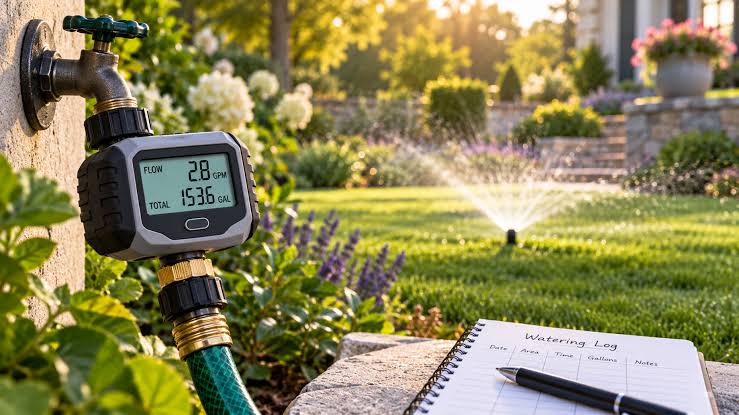
A more practical option for regular use is a hose-end water flow meter. It screws onto the standard garden hose thread between the tap and the hose and shows you, on a small display, how much water has passed through and how fast it is flowing. RESTMO’s range of hose flow meters, for example, uses the common US 3/4-inch garden hose thread, reads in gallons by default with an option to switch to liters, and in several models tracks both single-session use and flow rate; a few connect to a phone app for logging over time.
Once a meter is on the hose, you stop guessing. You can see that the vegetable bed took 14 gallons tonight, that the front lawn took 40, and that your flow drops in the early evening when the neighbors are watering too. That kind of information is what turns good intentions into real savings.
Step 2: Use the Right Watering Tool for Each Area
The tool at the end of the hose matters as much as the hose itself. A wide, hard spray on a high setting is quick, but a lot of it bounces off leaves, drifts in the wind, and runs off before it soaks in.
For beds, pots, and new plantings, a watering wand with a gentle shower setting and a shut-off valve lets you put water right at the base of each plant, where roots can use it. A good guide to choosing the best watering wand for your garden will walk through length, spray patterns, and grip, but the main points are simple: you want a soft spray for delicate plants, enough reach for baskets and back-of-border plants, and a thumb or trigger control so water stops the moment you move between plants.
For lawns, a sprinkler that throws large drops low to the ground loses less to wind and evaporation than a fine mist. For long rows of vegetables or shrubs, a soaker hose laid at the base of the plants gets water into the soil with almost nothing lost to the air.
A quick match-up
| Area | Tool that tends to waste least | Why |
| Containers and hanging baskets | Watering wand on a soft shower setting | Precise, reaches high and low, stops between pots |
| Flower and vegetable beds | Wand at the base, or a soaker hose | Water goes to roots, not leaves |
| New plantings | Wand on a gentle setting | Slow flow avoids washing soil away |
| Lawns | Low-angle sprinkler with large droplets | Less drift and evaporation |
| Long hedges or rows | Soaker hose | Slow, deep watering with little runoff |
Step 3: Work Out What Your Garden Actually Needs
Measuring the water going out only helps if you know how much should be going out.
Lawns
A common rule of thumb for established lawns is about 1 inch of water a week, from rain and watering combined, during the growing season. Cooler weather, shade, and some grass types need less; hot, windy weather and sandy soil can need more.
To translate that into gallons: 1 inch of water over 1,000 square feet is roughly 620 gallons. If your back lawn is about 500 square feet, that is around 310 gallons a week in dry weather. With a flow meter on the hose, you can see whether your sprinkler sessions are anywhere close.
Beds and vegetables
Most vegetables and flower beds also do well with around 1 inch a week, ideally given in one or two deep waterings rather than a little every day. Deep watering pushes roots further down, where the soil stays moist longer. Containers are different: they dry out fast and may need watering daily in summer, but in smaller amounts.
Check the soil, not the surface
Push a finger or a simple trowel a couple of inches into the soil. If it is moist there, the plants are fine, even if the top looks dry. If it is dry two inches down, it is time to water. For lawns, a long screwdriver pushed into the turf works as a rough test; if it slides in easily for several inches, the soil has enough water.
Step 4: Record and Compare
Measurement becomes useful when you write it down. You do not need anything fancy. A note on your phone or a small notebook in the shed is enough.
For each watering, jot down the date, the area, the gallons used, and the weather. After two or three weeks, patterns start to appear:
- One bed is always getting twice what the others get.
- The lawn gets far more on weekends than on weekdays.
- You water after rain out of habit.
- Flow drops in the evening, so evening sessions deliver less than you think.
If your flow meter has an app or a history feature, it can keep this record for you. Either way, compare each area’s weekly total with what it needs. Where you are giving more, cut back. Where you are giving less, add a little. Then check the plants: are they healthier, the same, or struggling? Adjust from there.
Step 5: Change the Habits That Waste the Most
With numbers in hand, the biggest savings usually come from a few habits.
Water early in the morning
Cooler air and lighter wind in the early morning mean less evaporation. Leaves dry off during the day, which lowers the risk of fungal problems. Evening is the next best time, though wet leaves overnight can encourage disease in some plants.
Water deeply, less often
Several short sprinklings keep only the top inch of soil damp and train roots to stay shallow. One or two longer sessions a week encourage deeper roots that cope better with heat.
Stop runoff
If water starts running off the lawn or onto the path, stop for 15 to 20 minutes, let it soak in, then continue. This “cycle and soak” approach is especially helpful on slopes and clay soil.
Skip watering after rain
A simple rain gauge, or even a straight-sided can left in the garden, tells you how much fell. If you got an inch, you may not need to water that week at all.
Fix leaks
A dripping hose connection can waste a surprising amount of water over a summer. Check washers and connections at the tap, at any splitters, and at the nozzle. A flow meter that shows flow when every tool is shut off is a clear sign of a leak somewhere in the line.
Mulch the beds
A 2 to 3 inch layer of mulch over the soil slows evaporation, keeps roots cooler, and reduces how often you need to water.
Step 6: Plan Your Garden Around Water
Over time, the garden itself can be shaped to use less.
Group plants with similar water needs together, so one area does not get overwatered just because a thirsty plant sits next to a drought-tolerant one. Consider native or climate-suited plants in the sunniest, driest spots. Reduce lawn in areas that are hard to water evenly, such as narrow strips beside driveways. And place containers where they get some afternoon shade, which cuts how often they need water in summer.
A Real-World Example: One Summer With a Flow Meter
A homeowner in a warm, dry part of the United States had a small back lawn, three raised vegetable beds, and a dozen pots on the patio. Her water bill climbed every summer, but she was sure she was not overwatering.
She put a flow meter on the hose in early June and kept a simple log. Within two weeks the numbers told a different story. The lawn, about 600 square feet, was getting roughly 650 gallons a week, nearly twice the 1 inch it needed. The vegetable beds, by contrast, were getting short, shallow sprinkles that barely reached the roots. The pots were fine.
She made three changes. She cut lawn watering to two deeper sessions a week, early in the morning, with a break halfway through to stop runoff. She switched from a spray nozzle to a watering wand for the beds and watered at the base of each plant. And she added mulch to the beds.
By August, the lawn was getting about 380 gallons a week and looked just as green. The vegetables were producing more because their roots were finally getting a proper soak. Her summer outdoor water use dropped noticeably compared with the year before, and she kept the meter on the hose for the next season.
Common Mistakes to Avoid
- Judging by the surface instead of checking a couple of inches down.
- Watering every day for a few minutes instead of deeply once or twice a week.
- Using a hard, wide spray on beds and pots.
- Watering in the middle of a hot, windy afternoon.
- Ignoring runoff onto paths and driveways.
- Watering out of habit right after rain.
- Leaving small leaks at hose connections unfixed.
Frequently Asked Questions
How do I measure how much water my garden hose uses?
Time how long it takes to fill a bucket of known size, or fit a hose-end flow meter that displays gallons used and flow rate for each watering session.
How much water does a lawn need per week?
A common guideline for established lawns is about 1 inch a week during the growing season, including rain. That works out to roughly 620 gallons for every 1,000 square feet.
Is a watering wand better than a spray nozzle?
For beds, pots, and new plants, usually yes. A wand lets you apply a gentle stream at the base of each plant, which wastes less water than a wide spray.
When is the best time of day to water the garden?
Early morning, when it is cooler and less windy. Less water evaporates, and leaves dry during the day.
How can a flow meter help me save water?
It shows exactly how much water each area gets, so you can spot overwatering, uneven watering, and leaks, and adjust your habits based on real numbers rather than guesses.
Do I need to water after it rains?
Often not. Check how much rain fell with a rain gauge or a straight-sided can. If you got around an inch, you may be able to skip that week’s watering.