
The hidden payroll cost, FUTA Credit Reduction in California
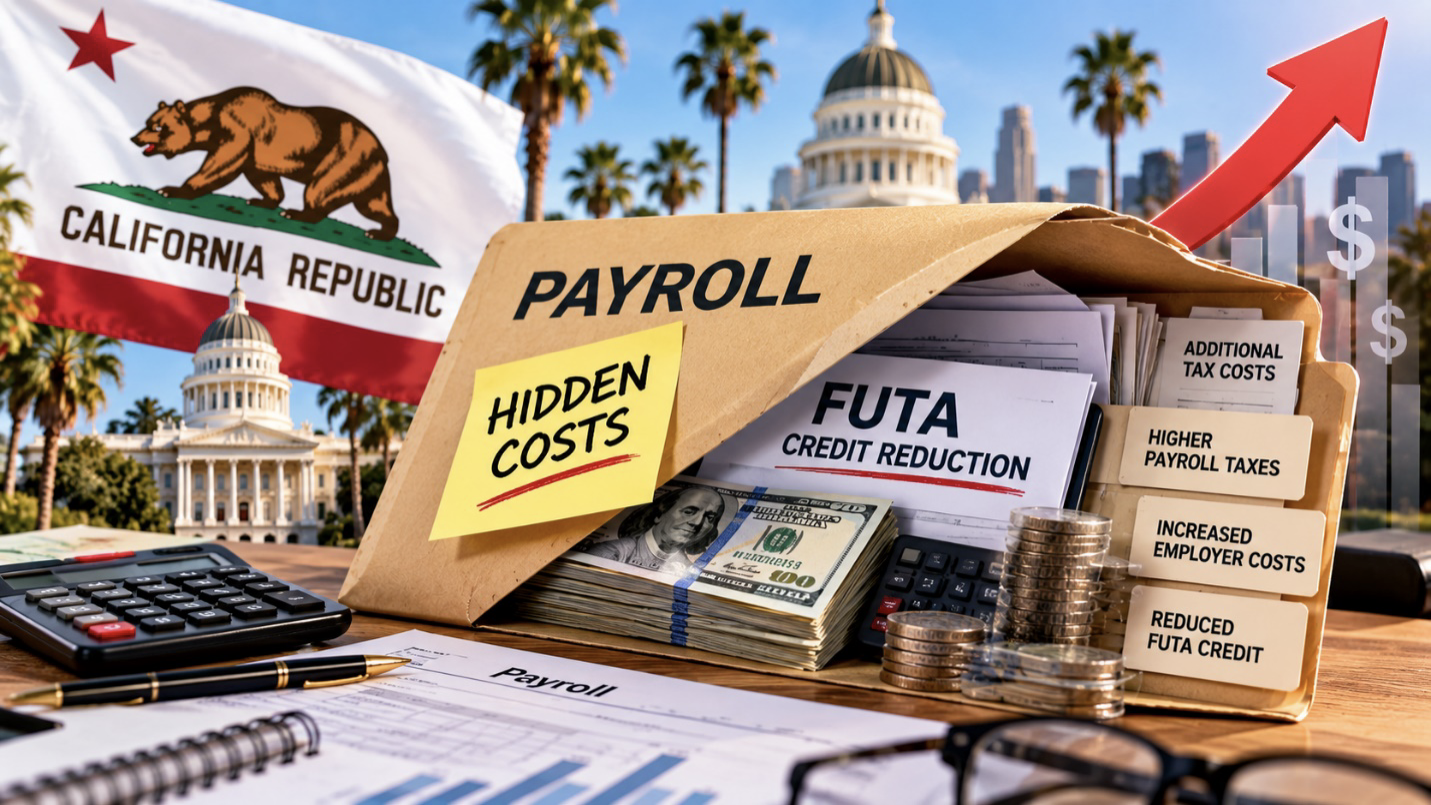
An under-discussed payroll cost is the state’s unemployment insurance (UI) trust fund debt that California employers are facing. If a state has qualifying federal unemployment loans, employers may forfeit a portion of the federal FUTA tax credit, which will raise the amount of federal unemployment tax due.
There is a significant federal debt owed in the state of California. The U.S. Department of Labor in February 2026 estimated California’s federal borrowed funds in the unemployment system at $21 billion. Look for an expert (like an EDD tax attorney) who will understand your situation and find the right path on your behalf.
This can result in an increase in California businesses’ federal payroll expenses.
The normal operation of FUTA
The Federal Unemployment Tax Act (FUTA) normally levies a tax rate of 6% on the first $7,000 of FUTA-taxable wages each pay period for every worker. Employers are eligible for a credit of up to 5.4% of qualifying state unemployment taxes; this lowers the effective federal rate to 0.6%.
That translates to a maximum standard FUTA cost of:
$7,000 × 0.6% = $42 per employee
However, employers in a FUTA credit-reduction state get a lower credit.
What’s a FUTA Credit Reduction?
Federal law lowers FUTA credit for employers in a state where there are outstanding federal unemployment loans for the necessary length of time.
At the base level, it is lower by 0.3 percentage points and can go up by an additional 0.3 percentage point for each of the following years if the qualifying debt is still outstanding. Other federal rules also allow for further cuts.
The credit-reduction rate for California was 1.2% for 2025.
To illustrate, if the 1.2% FUTA rate was applied to the $7,000 FUTA wage base, the additional employer contribution would be $84 per affected employee when compared to the standard 0.6% FUTA rate.
What About 2026?
The precise rate of credit reduction for 2026 in California should be verified with the determination made by the Department of Labor on an annual basis. Each year after November 10, the IRS will inform DOL of the states in which a credit reduction takes effect and the rates in those states.
Employers should not just use last year’s percentage, but also check to see which 2026 percentage is to be applied.
In the case of California’s UI system, the extra FUTA expense will impact employers who pay wages in California.
Why Should Business Owners Care?
This extra expense can be relatively small for each employee, but can add up for a large staff.
For instance, if there were an additional 84 employees on the job who are impacted, then that would cost another $84 for each employee impacted.
- 10 employees: $840
- 50 employees: $4,200
- 100 employees: $8,400
- 500 employees: $42,000
These costs are not deducted from employee salaries, but are covered by an employer. Hiring an experienced professional is mandatory to tackle a CDTFA auditand similar things.
California Employers: There are tips for you!
To avoid surprises:
- Discuss the annual FUTA credit-reduction rate. Don’t assume that the rate for last year is the same.
- Track your $7,000 FUTA wage base. The general rule with FUTA is that only the first $7,000 in wages per employee are subject to the tax.
- Budget for Form 940. Credit-reduction amounts are reported on Form 940 and Schedule A (if applicable).
- Coordinate payroll records. Ensure that the correct wages and wages subject to FUTA are reported for California UI.
- Keep an eye out for the November decision. The applicable credit-reduction status might impact year-end payroll calculations.
- Partner with your payroll service or tax professional. Other reporting considerations may apply to multi-state employers.
The financing dilemma for the UI system in California can impact employers in more ways than their state unemployment tax bill. Federal unemployment tax and FUTA credit can be increased due to a qualifying federal loan balance.
This will be a critical payroll-planning question for California businesses in 2026 when FUTA credit reductions begin. Each year, the DOL determines the FUTA rate; the Form 940 requirements should be reviewed, and anticipated increases in FUTA liability should be budgeted to avoid an unexpected payroll expense at the end of the year.