
When a Guest Stops Breathing Mid-Dinner: What Your Restaurant Team Should Know
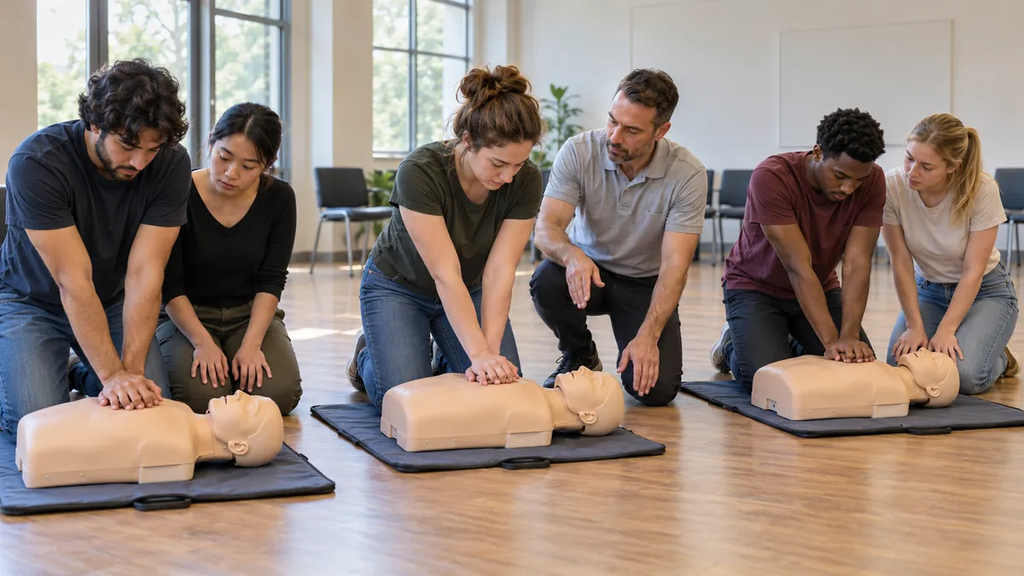
Restaurant teams train for everything: allergens, knife skills, closing checklists. But when a guest slumps over a plate or a cook collapses by the grill, the training that counts is CPR C and AED. Here’s what that means, what Ontario expects from employers, and how to get your team ready without losing a service.
This guide is written for Ontario restaurants. Rules in other provinces and countries differ, so check your own.
What Emergencies Happen in a Restaurant?
Most shifts are routine. The ones that aren’t tend to fall into a few groups:
- Choking. A guest eating fast, a child with a big bite, a staff member on a quick break.
- Burns and scalds. Hot oil, steam, boiling water and hot pans.
- Cuts. Knives, slicers, broken glass and can lids.
- Slips and falls. Wet floors, spilled drinks and crowded aisles.
- Allergic reactions. A guest or staff member reacting to something they ate or touched.
- Fainting. Long shifts, heat and skipped meals in a hot kitchen.
- Cardiac arrest. Rare in any one restaurant, but it can happen to a guest or a team member at any time.
Not all of these need CPR. But some of them need it fast, and the rest benefit from people who stay calm and know what to do.
What Does CPR C and AED Actually Cover?
CPR Level C is the full-strength version of CPR training. It covers adults, children and infants, which matters in a dining room where families bring babies and toddlers. It also includes choking response, two-rescuer CPR and how to use an AED.
An AED (automated external defibrillator) is a portable device that can deliver a shock to restart a heart rhythm in some cardiac arrests. It talks you through each step, but people who’ve practised with one hesitate less.
The course is hands-on. You work on mannequins, use an AED trainer, and practise choking response with an instructor watching your technique. Certification is typically valid for three years.
Why Is a Dining Room Different From Other Workplaces?
Because of how it runs.
It’s loud. Music, kitchen noise and chatter can hide an emergency. A guest may collapse at a table without anyone noticing for a moment.
It’s full of strangers. You don’t know your guests’ ages or health histories. Some may be very young or elderly.
Roles are split. Servers, hosts, cooks, dishwashers and managers are all in different places. Nobody has a clear view of the whole room.
The address can be confusing. Many restaurants sit in plazas, malls or strips with shared entrances. A paramedic may not know which door to use.
That last point is easy to fix. Decide who calls 9-1-1, who goes to the door to meet the ambulance, and who fetches the AED. Practise it so it’s automatic.
What Does Ontario Require From Restaurant Employers?
In Ontario, workplace first aid requirements are set by WSIB Regulation 1101. It applies to workplaces with WSIB-covered employers. If you aren’t sure whether your restaurant is covered, the WSIB can confirm. The Ontario Occupational Health and Safety Act (OHSA) also sets general duties for employers to protect workers.
The thresholds depend on how many workers are on a shift:
- 1 to 5 workers per shift: at least one worker with Basic First Aid
- 6 or more workers per shift: at least one worker with Intermediate First Aid
- 200 or more workers per shift: a first aid room with a qualified attendant
Certificates are valid for three years.
Notice that the rule counts workers per shift. Restaurants run split shifts, staggered closers and busy weekends. A trained person who works Tuesday lunch doesn’t help on Saturday night.
On June 22, 2026, the WSIB aligned its First Aid Program with the national CSA Z1210:24 standard. Emergency First Aid became Basic First Aid, and Standard First Aid became Intermediate First Aid. The thresholds did not change, and earlier certificates stay valid until they expire. Only providers the WSIB lists can deliver the new certifications, so check your provider before you book.
Basic and Intermediate First Aid courses usually include CPR Level C and AED training. If you’re only considering a CPR course, ask your provider or the WSIB whether it meets your workplace requirement.
How Do You Cover Every Shift?
Start with your schedule, not your staff list.
- Map your shifts. List every shift, including opens, closes, weekends and holidays, and note how many workers are on each.
- Pick the level. Match it to the thresholds above.
- Choose people who are there. Shift leads, supervisors and long-serving staff who work regular hours are good candidates.
- Plan backups. Train at least one extra person per shift for sick days and vacations.
- Include closers. Late shifts often have fewer people and less supervision.
- Write it down. Keep a one-page list of first aiders by shift in your manager’s binder, and post it where staff can see it.
- Track expiry dates. Put renewals in your calendar well ahead of time.
How Do You Train Without Closing the Kitchen?
Plan it around your slowest days.
Stagger your people. Don’t send the whole team at once. Train one or two at a time.
Use a blended format. Many providers let you do the theory online at your own pace, then attend a shorter in-person session for hands-on skills. That keeps time away from the floor to a minimum.
Consider a private session. If you have several staff, ask about on-site group training. Providers set minimum group sizes, so check first.
To see what’s available, look at the Coast2Coast First Aid scheduling options and choose a date that avoids your busiest weeks.
What Should the Team Practise?
A short drill every month keeps skills fresh. Ten minutes at a pre-shift meeting is enough.
Try a scenario like this: “A guest at table twelve is choking and can’t speak.” Then walk through it:
- Who calls 9-1-1? One person, by name.
- Who gets the AED? If you have one, someone fetches it.
- Who meets the ambulance? Someone goes to the door and brings paramedics in.
- Who keeps the room calm? Someone moves other guests away and shields the scene.
- Who gives care? The trained first aider takes the lead.
Change the scenario each month: a burn on the line, a cook who faints, a guest with a severe allergic reaction. Afterwards, ask what worked and what felt confusing.
What About the Kit and Equipment?
Keep a first aid kit that suits a kitchen. That means burn dressings, bandages for cuts, gloves and the usual supplies. Check it monthly and restock what’s low. Put it somewhere everyone knows, not locked in an office.
If you have an AED, mark where it is and make sure staff know how to reach it quickly. Check the pads and battery dates on a schedule.
Why Does It Matter?
Because every minute counts. According to Heart & Stroke, an estimated 60,000 cardiac arrests happen outside hospitals in Canada every year, and only one in 10 people survives. Nearly half happen to people under 65, so this isn’t only a concern for older guests. It affects your team, too.
Heart & Stroke also says fast action, meaning CPR and an AED, can double a person’s chance of survival. Every minute without CPR or defibrillation lowers the odds by about 10%. In a busy restaurant, a trained team can make those first minutes count.
If you are looking for first aid training near Kennedy Road South and Queen Street, the Bramalea City Centre area, or surrounding areas in Brampton, you may reach out to Coast2Coast First Aid & Aquatics in that area.
FAQs
Q: What does CPR C and AED cover?
A: CPR Level C covers adults, children and infants, including choking response, two-rescuer CPR and AED use. The course is hands-on, with practice on mannequins and an AED trainer.
Q: How many first aiders does an Ontario restaurant need?
A: It depends on workers per shift. For one to five, at least one worker should hold Basic First Aid. For six or more, at least one should hold Intermediate First Aid. Confirm how it applies to you with the WSIB.
Q: Does a CPR course meet the workplace first aid requirement?
A: Regulation 1101 refers to Basic and Intermediate First Aid, which usually include CPR Level C and AED. Ask your provider or the WSIB whether a CPR-only course meets your requirement before you rely on it.
Q: How long is a workplace first aid certificate valid in Ontario?
A: Three years.
Q: What changed in Ontario’s first aid program in 2026?
A: On June 22, 2026, the WSIB aligned its program with CSA Z1210:24. Emergency First Aid is now Basic First Aid, and Standard First Aid is now Intermediate First Aid. Thresholds are unchanged, and earlier certificates stay valid until they expire.