
Moving a Shop’s Equipment: Separating Transport Day From Opening Day
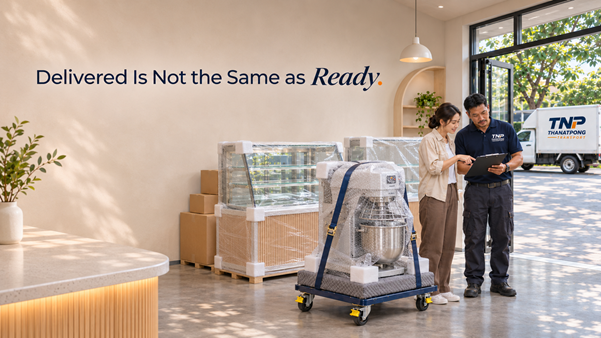
“Delivered” and “ready to serve customers” describe different milestones. A shop can have every piece of equipment inside its new premises while still waiting for connections, installation checks, or a usable working layout. Treating the delivery date as the opening date leaves all of that unfinished work competing with the first customer’s arrival.
A better schedule separates preparation at the old shop, physical transport, and installation at the new one. The owner coordinates those stages, the carrier handles the agreed transport work, and appropriately qualified technicians handle technical preparation and recommissioning. The opening decision belongs after the necessary work and checks, not automatically at the end of unloading.
Disconnect and Prepare Before Collection Day
Imagine a neighborhood bakery in Nonthaburi moving to a larger storefront. This hypothetical business has a mixer, a commercial dishwasher, worktables, and display fittings. Some items can be prepared as movable goods; others depend on electrical, water, drainage, or other connections that require technical attention. Putting them all on one inventory does not make their preparation identical.
The owner needs the relevant equipment instructions and a conversation with the people qualified to prepare each connected item. Electrical, gas, water, and machinery disconnection should be assigned to appropriately qualified technicians, with manufacturer requirements and applicable local conditions guiding the work. Transport workers should not be expected to improvise technical disconnection when they arrive to collect.
Manufacturer guidance illustrates why the distinction matters. La Marzocco’s GS/3 manual, for example, specifies qualified and authorized personnel for installation and calls for checks on the electrical supply. That is not a universal instruction for every appliance in the bakery. It shows why the actual model’s requirements matter more than an assumption that a machine can simply be moved and plugged in again.
Collection readiness should therefore mean more than the final trading shift having ended. The responsible technician may need access after production stops, and the owner must know when each item can be released for packing and handling. If that work is unfinished, the collection arrangement needs attention; the vehicle’s arrival cannot resolve a technical dependency.
The owner’s discussion with TNP Thanatpong Transport can define the transport scope against that preparation: which items will be ready, what packing or handling is requested, and where the agreed transport work ends. Technical preparation and installation remain separately assigned unless an appropriate arrangement has actually been confirmed. A carrier is not a substitute for the equipment technician.
Make the Route From Door to Vehicle Work
A machine’s operating position can conceal the difficulty of moving it. The bakery’s dishwasher might fit comfortably beneath a counter but have no clear route past a fixed display. Its worktable might pass through the shop door while its protective packaging cannot. A street address and a list of equipment leave those problems invisible.
The route at both shops includes doors, turns, steps, and the vehicle’s stopping point. Packed dimensions and reliable weights help the provider assess the work.
Where a fitting obstructs the route, the owner needs to arrange an appropriate solution before collection. That does not mean asking staff to tilt a machine, remove a structural element, or attempt an unfamiliar lift to make the booking work. Unresolved handling risks need competent assessment and an agreed plan, not a last-minute experiment beside the truck.
The destination route matters just as much as the exit. In the hypothetical bakery, the new preparation area could be behind the customer counter, with only a narrow opening available. The owner and installation team need to understand where equipment should be received and what space must remain accessible for connection and servicing. Delivery to an entrance and placement in a final operating position are different scopes.
Keeping that distinction visible helps prevent repeated handling. If a worktable is delivered across the route intended for the dishwasher, the next stage becomes harder. A simple agreed receiving layout can show where movable items belong while leaving the installation area clear. The transport team should receive the relevant placement instructions before unloading begins, within the work it has accepted.
Leave Time for Installation Before Opening
The bakery’s opening schedule should be built around the work that follows delivery. Equipment may need positioning, reconnection, setup, and checks by the appropriate people before use. The exact sequence depends on the machines and the new premises. There is no responsible universal waiting period that turns every delivered shop into an operational one.
Hobart’s commercial kitchen installation information distinguishes equipment positioning and connection from startup and commissioning. It also explains that existing utility rough-ins must be available for the installation appointment. For a relocating owner, the planning lesson is that having the machine on-site does not create the services or technical readiness it requires.
Technicians should therefore confirm the new site’s requirements before the transport date is treated as fixed. A new outlet, water point, or drain being visible is not enough for the owner to judge compatibility. Any necessary building or utility preparation belongs with the people responsible for that work, and its completion needs to fit the installation schedule.
The calendar should preserve access for installation appointments. Display fittings placed in every spare corner could leave a technician unable to reach a machine. Cleaning and stocking also need room; a completed delivery is not a reason to fill every available space.
Before announcing normal trading, the bakery can base its decision on the required equipment checks and whether its intended service can actually be delivered. A delay in one essential machine might change what the business can offer, even though all items arrived. That is an operating decision for the owner with the relevant technical input, not a transport guarantee.
Transport day has done its job when the agreed goods reach the agreed receiving position. Opening day asks a different question: can the shop operate safely and as intended? Leaving room between those milestones protects the work needed to answer it.